
Enterprise Identity Middleware: Centralizing Multi-IdP OAuth at Scale
Enterprise application estates face severe combinatorial friction when managing multiple evolving Identity Providers (Azure AD, Ping, Okta, and legacy directories). Building a dedicated enterprise identity middleware layer decouples Single-Page Applications from IdP migrations, eliminates static client credentials via Vault and Workload Identity, and enforces Zero-Trust On-Behalf-Of (OBO) token delegation for autonomous AI agents.
This article focuses on enterprise organizational strategy, Multi-IdP federation, and AI Agent token governance. For the cryptographic fundamentals of PKCE, browser storage risks, and session cookie mechanics, refer to Part 1:
← Read Part 1: The Token Handler Pattern (Zero-Trust OAuth 2.0 for Modern SPAs)
Why Enterprises Build Custom Identity Middleware
Authentication infrastructure sits at the foundational layer of every digital product. In modern enterprise IT ecosystems, identity architectures rarely resemble the pristine "single application, single identity provider" diagrams found in introductory OAuth tutorials. Instead, enterprises grapple with diverse topologies:
- Heterogeneous Identity Providers: Coexisting systems such as Microsoft Entra ID (Azure AD) for corporate employees, PingIdentity / Okta for business partners, and legacy Oracle Access Manager (OAM) or SAML directories for on-premises mainframe systems.
- Proliferation of Frontends: Dozens of disparate Single-Page Applications across business lines—from healthcare patient portals and claims adjudication engines to fintech banking apps, wealth management portals, and payment gateways—each demanding secure authentication and token life-cycle management.
- Autonomous AI Agents: Intelligent LLM agents embedded within applications (such as clinical diagnostic co-pilots in healthcare or automated portfolio rebalancing agents in finance) that require delegated access to execute microservices on behalf of active users without ever holding persistent user credentials.
When organizations attempt to integrate each application directly with each identity provider, they create an unmanageable matrix of point-to-point integrations. Custom enterprise identity middleware abstracts these disparities behind a unified, battle-tested gateway.
The Combinatorial Integration Problem: N × M vs. N + M
Without a centralized middleware layer, every business application integrates directly with identity providers. The maintenance and security burden scales quadratically as N Applications × M Identity Providers.
In an organization with 25 applications and 3 identity providers, this model spawns up to 75 distinct integration points. Each integration requires registering unique redirect URIs, provisioning static client credentials, implementing custom token refresh timers, and passing independent security audits.
| Architectural Dimension | Direct Point-to-Point Integration | Enterprise Identity Middleware (BFF) |
|---|---|---|
| Integration Surface | N apps × M IdPs (Multiplicative Explosion) | N apps + M adapters (Linear Scaling) |
| IdP Migration Scope | Every application codebase must be updated | One adapter updated in the middleware layer |
| Redirect URIs to Manage | 1 per app × environment × IdP (Hundreds) | 1 set for the centralized BFF per IdP |
| Client Credential Storage | Scattered across 25+ app deployment pipelines | Centralized in HashiCorp Vault / GCP Secret Manager |
| Session Revocation | Impossible across disparate apps until JWT expires | Instant atomic revocation in central Redis store |
| AI Agent Token Governance | Static service accounts with broad blast radius | Dynamic RFC 8693 On-Behalf-Of token exchange |
Every business application routed through the identity middleware reduces the technical debt of future
IdP migrations. When migrating from a legacy provider to PingIdentity or Okta, zero lines of code in the
Angular/React business applications change. The platform team implements a single new
IdpAdapter in the BFF, switches a configuration flag, and tests once.
Advanced Token Handler Architecture: AI Agents & Vault Onboarding
Modern enterprise applications are rapidly moving beyond static dashboards to embed autonomous AI agents and LLM orchestrators. These agents need to query backend databases and invoke microservices on behalf of the user.
However, granting an AI agent long-lived service credentials creates catastrophic blast radius, while storing user bearer tokens in LLM context windows or vector databases introduces immediate data-leakage risks.
The comprehensive architectural solution combines dynamic startup credential onboarding, secure server-side session brokering, and RFC 8693 On-Behalf-Of (OBO) token exchange:
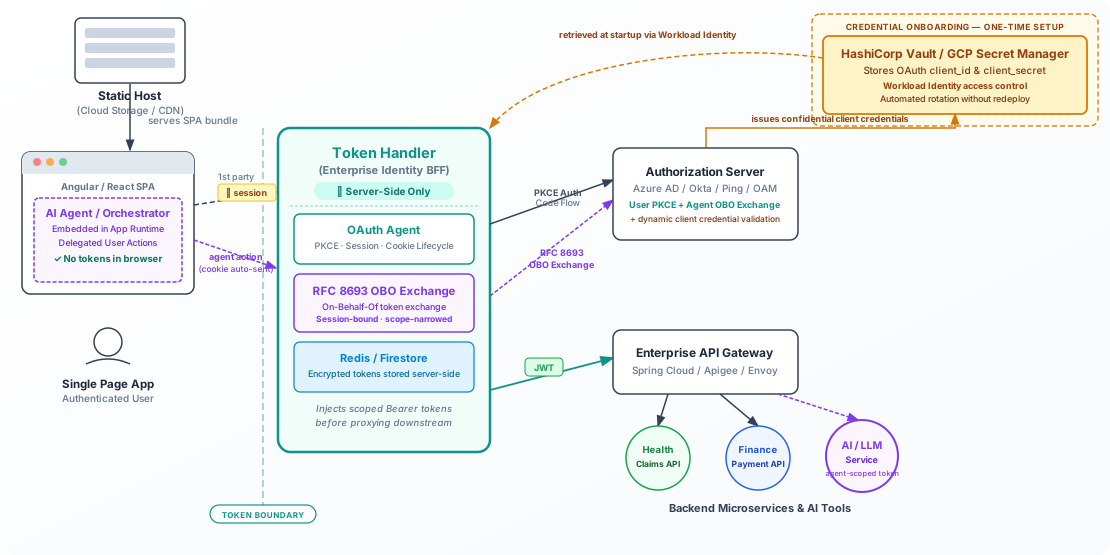
RFC 8693 On-Behalf-Of Tokens
Autonomous AI agents executing inside the client application act on the user's behalf but never hold raw credentials. When an agent requests a backend operation, the BFF presents the user's access token to the IdP via RFC 8693 token exchange, receiving an agent-specific token scoped strictly to that single tool invocation.
- Token scopes are a strict down-scoped subset of user privileges
- Audited provenance: logs show both the user and the agent identity
- Tokens expire in minutes, mitigating compromised prompt exposure
Vault & Workload Identity
OAuth confidential client credentials (client_id and client_secret) are
stored centrally in HashiCorp Vault or GCP Secret Manager. The BFF authenticates dynamically at
bootstrap using Workload Identity Federation without hardcoded keys.
- Zero static credentials in Git repositories or container images
- Credential rotation occurs in Vault without redeploying microservices
- Complete audit trail of every credential read event
Session-Bound Agent Lifecycles
Every agent delegation token is cryptographically bound to the user's primary session. When the user logs out or the idle timer elapses, the BFF deletes the session from Redis. All active agent delegations derived from that session are invalidated immediately.
- No orphaned AI agent processes continuing post-logout
- Instant administrative revocation across all active user agents
- Sliding idle windows prevent unattended automated abuse
Credential Onboarding: Eliminating Static Secrets
Securing user tokens at runtime is only half the battle. A major vulnerability in many architectures is how the BFF itself acquires its client credentials. In naive setups, client secrets are baked into container environment variables or committed to repository configurations.
The enterprise middleware pattern implements secretless deployment via platform-level identity federation:
roles/secretmanager.secretAccessor).
Implementation Architecture: Spring Boot & Reactive Gateway
The enterprise middleware is typically built as a high-throughput, non-blocking service using Spring Boot 3 (Java 17/21) with Spring Cloud Gateway and Spring WebFlux.
Key Component Responsibilities
- Pluggable
IdpAdapterSPI: Encapsulates unique IdP quirks behind a clean interface. Proprietary headers (such as domain tags in Oracle Access Manager or tenant UUID paths in Microsoft Entra) are handled entirely within their respective adapter classes:public interface IdpAdapter { Mono<AuthorizationRequest> buildAuthorizationUrl(String clientId, String redirectUri, String state, String codeChallenge); Mono<TokenResponse> exchangeCodeForTokens(String code, String codeVerifier, OAuthClientCredentials credentials); Mono<TokenResponse> exchangeOnBehalfOfToken(String userToken, String requestedScope, OAuthClientCredentials credentials); Mono<TokenResponse> refreshAccessToken(String refreshToken, OAuthClientCredentials credentials); } - Multi-Tenant Registry via YAML: Adding a new enterprise application requires only a
declarative configuration block—zero Java code modifications:
bff: applications: # Healthcare Domain: PHI & Clinical Claims (HIPAA Scope) healthcare-claims: target-idp: entra-id session-timeout-minutes: 15 allowed-origins: - "https://claims.health.enterprise.com" vault-secret-path: "secret/data/bff/healthcare-claims" # Financial Services Domain: Payment & Wealth Management (PCI Scope) fintech-payments: target-idp: ping-identity session-timeout-minutes: 15 allowed-origins: - "https://pay.finance.enterprise.com" vault-secret-path: "secret/data/bff/fintech-payments" - Distributed Token Store: Stateful session records are maintained in Redis (or Google Cloud Firestore) with encrypted payloads. Deleting a key instantly revokes the session across all gateway nodes.
- Distributed Correlation Tracing: The BFF stamps every incoming browser request with a
unique correlation ID (e.g.,
X-Correlation-ID), propagating it downstream through the API Gateway to all microservices for comprehensive distributed logging.
References & Standards
-
RFC 8693 — OAuth 2.0 Token Exchange. Defines the standard token-exchange framework
enabling On-Behalf-Of delegation for enterprise AI agents.
https://www.rfc-editor.org/rfc/rfc8693 -
NIST Special Publication 800-63C — Digital Identity Guidelines: Federation and
Assertions. Establishes federal guidelines for identity brokers and token binding.
https://pages.nist.gov/800-63-3/sp800-63c.html -
draft-ietf-oauth-browser-based-apps — OAuth 2.0 for Browser-Based Applications. IETF
Best Current Practice for securing Single-Page Applications.
https://datatracker.ietf.org/doc/html/draft-ietf-oauth-browser-based-apps -
Google Cloud Workload Identity Federation — Eliminating Service Account Keys using OIDC
and SAML trust relationships.
https://cloud.google.com/iam/docs/workload-identity-federation -
HashiCorp Vault Documentation — Dynamic Secrets, Identity Secrets Engine, and Transit
Encryption.
https://developer.hashicorp.com/vault/docs