
From AI-Ready to AI-Native: Designing Systems for AI Agents
Most enterprises today describe themselves as AI-Ready. They have cloud infrastructure, centralized data platforms, and APIs capable of supporting machine learning models. Yet these systems were fundamentally designed for a different primary consumer: human-operated user interfaces.
Becoming AI-Native requires a deeper architectural shift—one that acknowledges AI agents as first-class consumers of enterprise systems.
Modern AI agent frameworks—such as Model Context Protocol (MCP), tool-calling interfaces, and planner–executor architectures—are changing how intelligence is embedded into applications. These frameworks enable large language models to interpret intent, plan multi-step actions, invoke tools and APIs, and synthesize outcomes on behalf of users. However, their effectiveness is constrained by the systems they interact with. AI agents can only be as capable as the APIs, data, and governance layers they are built upon.
The transition from AI-Ready to AI-Native is therefore not about adding an LLM to an existing stack. It is about designing systems where APIs are optimized for agent consumption, data platforms are structured for learning and reasoning, and orchestration layers support planning, tool invocation, and contextual decision-making.
In an AI-Native architecture, APIs are no longer designed solely to support screens and clicks. Instead, they are exposed as tools—well-defined, semantically rich, and context-aware—that AI agents can discover, reason over, and invoke dynamically. Protocols like MCP formalize this interaction, enabling consistent contracts between agents and enterprise capabilities, while planners determine what actions to take and executors determine how to carry them out.
From a consumer perspective, this shift manifests as conversational interfaces replacing traditional portals. Users express intent in natural language, while AI agents translate that intent into structured plans, invoke the appropriate tools, and return outcomes—not raw data. Humans move from navigating systems to supervising intelligent agents that act on their behalf.
Becoming AI-Native means embracing this reality: the primary interface to your enterprise is no longer the UI—it is the AI agent. And that single change fundamentally reshapes how applications, APIs, and data platforms must be designed.
Augmenting API Layer for Machine Learning Consumption
Traditionally, APIs were built to support digital applications, responding directly to user interactions. For example, a 'Get Member Details' API would be called when a user clicks their profile, fetching just enough information (like name and ID) to display on the screen. This is an 'AI-Ready' approach. To become 'AI-Native', these APIs must be augmented for consumption by AI and machine learning models. The same 'Get Member Details' API might now need to provide a much richer dataset for an AI agent—such as the member's full history, preferences, and location—to predict their needs or recommend a new service. This shift requires APIs to be more than just data-fetching tools; they must provide the deep, contextual data that machine learning models need to function intelligently. By augmenting APIs for ML, an organization enables its systems to be truly driven by AI, not just supplemented by it.
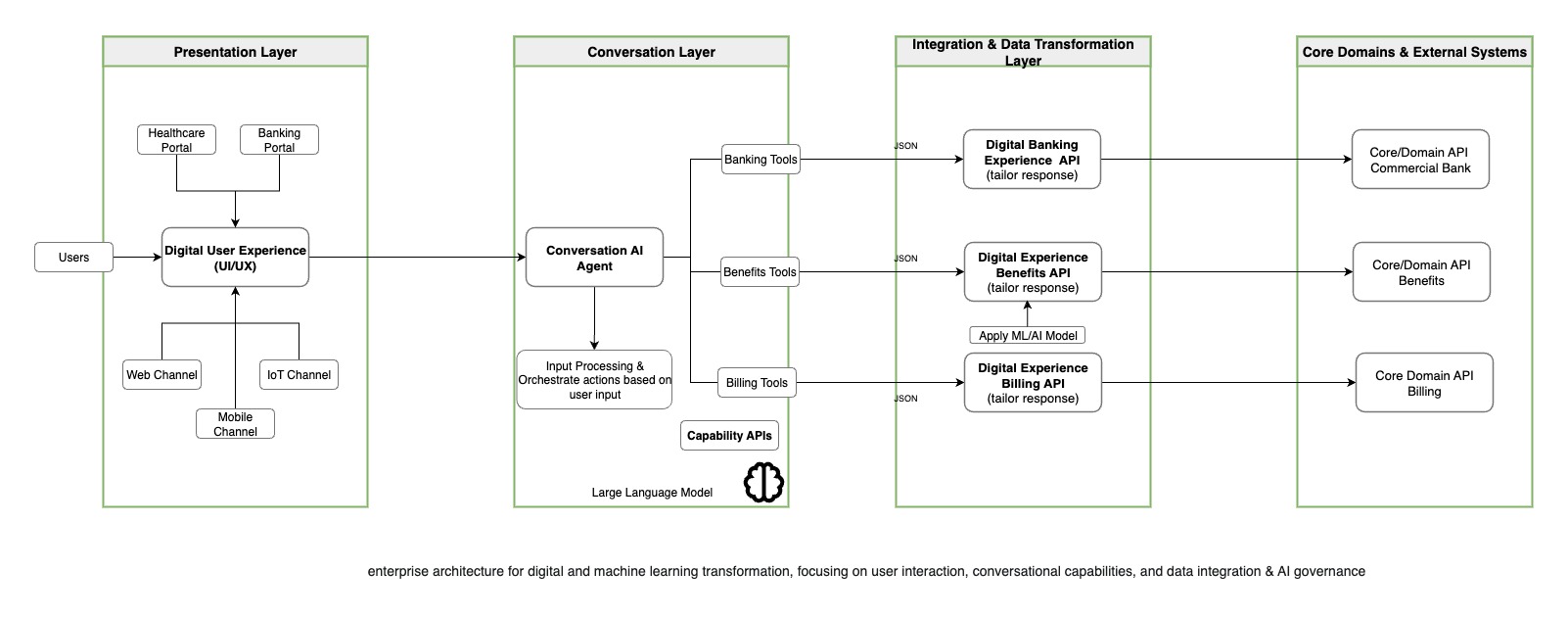
I want to highlight the layers of the AI Agent Pattern architecture that are impacted by this shift: the presentation layer where UI/UX would be built would integreate with Conversation AI Agent layers which is fundamentally responsibel for interpreting user inputs, extracting the key entity information and invoking the right subtool/agents for fulfilling those requests. The Conversation AI Agent layer would then interact with the API layer which is augmented for ML consumption. This API layer would then interact with the data layer which is optimized for ML workloads.
Presentation Layer
This layer encompasses all user-facing interfaces.
- User Interfaces (UI/UX): Central hub for user interaction, fed by various access channels.
- Access Channels:
- Digitals Access Portal: A dedicated web application for your users
- Mobile: Native mobile applications as a user interface.
- Web: Browser-based applications as a user interface.
- IoT Devices: Integration with connected devices for interaction or data capture such as Watches/Devices.
Conversation Layer
This is the intelligence and orchestration hub for user interactions.
- Conversation Agents / Orchestrator: The agent understands user requests in everyday language. It identifies and extracts key information, such as locations, dates, or medical reasons. Once it has the necessary details, the agent uses its tools to complete the task. Finally, it translates the raw data into a clear, grammatically correct, and easy-to-understand response.
- Capability APIs: These expose core business functions/capabilities to the
Conversation Layer.
- Banking Capability API: Manages consumer banking related inquiries and functionalities.
- Benefits Capability API: Responsible for handling any of the health benefits related to inquiries and actions.
- Scheduling Capability API: Manages scheduling-related tasks.
- Member ID Card Capability API: Manages member identity card inquiries and functionalities.
API Transformation / Data Integration Layer
This layer is responsible for translating and enriching data between the Conversation Layer and backend systems.
- Experience API Layer: Acts as a gateway, tailoring responses based on the consuming platform, consumer context, or desired format (e.g., JSON,XML, etc). This layer often applies machine learning models for personalization, recommendations, or data enrichment. This layer also handles the data integration with the backend systems.
Source/Domain Systems (Internal/External)
The ultimate providers of data and business logic. These include internal enterprise systems (e.g., Core Banking, Billing, Claims) and external third-party services.
- Core Banking: Manages consumer banking related inquiries and functionalities.
- Billing: Manages billing-related tasks.
- Claims: Manages claim-related inquiries and functionalities.
- Scheduling: Manages scheduling-related tasks.
AI Governance and Security
As AI becomes more integrated into core business functions, robust governance and security become paramount.
- AI Governance: This establishes the framework for using AI responsibly and ethically. It includes practices like ensuring model transparency and explainability (understanding why an AI made a certain decision), monitoring for and mitigating bias, maintaining audit trails of AI actions, and ensuring compliance with industry regulations and data privacy standards.
- Security: This focuses on protecting the entire AI ecosystem. Key security measures include safeguarding AI models from being stolen or tampered with, preventing data poisoning (where malicious data is used to corrupt the model's learning process), securing the APIs that connect to the AI, and implementing strong access controls to ensure only authorized users and systems can interact with the AI agents.
Observability and Monitoring
Ensuring the health, performance, and reliability of AI agents and their underlying systems is critical. This layer focuses on comprehensive monitoring and logging across the entire AI ecosystem.
- Logging: Capturing detailed records of all interactions, decisions, and system events. This includes input prompts, AI responses, tool usage, errors, and system performance metrics. Effective logging is crucial for debugging, auditing, and understanding AI behavior.
- Monitoring: Continuously tracking key performance indicators (KPIs) and
operational
metrics. This involves:
- AI Model Performance: Monitoring accuracy, latency, throughput, and drift (how well the model maintains its performance over time with new data).
- System Health: Tracking CPU usage, memory, network activity, and API response times for all components.
- User Experience: Monitoring user satisfaction, engagement, and error rates to identify areas for improvement.
Becoming AI-Native: Designing for Planners, Tools, and Trust
AI-Native architecture emerges when systems are intentionally designed for AI agents—not retrofitted to accommodate them. As agent frameworks mature, patterns such as planners, tool calling, and protocol-driven interoperability are becoming the backbone of intelligent applications. Enterprises that ignore this shift risk building AI agents that are brittle, constrained, and overly dependent on human-driven workflows.
In an AI-Native enterprise:
- APIs are exposed as agent tools, not UI endpoints.
- Planner–executor patterns guide multi-step reasoning and task completion.
- Data platforms prioritize context, memory, and learning, not just transactions.
- Protocols like MCP standardize how agents discover and interact with capabilities.
- Governance, security, and observability are embedded directly into agent execution paths.
The path forward is evolutionary but intentional:
- Identify APIs that will be consumed by AI agents and planners.
- Redesign them as semantically rich, context-aware tools.
- Introduce conversational orchestration layers that support planning, execution, and fallback.
- Implement observability that captures agent decisions, tool usage, and model drift.
- Establish governance policies that ensure AI agents operate transparently, securely, and ethically.
AI-Native systems do not eliminate human involvement—they elevate it. Humans shift from executing workflows to defining intent, policies, and guardrails, while AI agents handle execution at machine speed and scale. Organizations that design for agents today will define how digital systems are experienced tomorrow and will gain a significant competitive advantage in digital experiences and operations.