Open Knowledge Format: Standardizing Metadata for Zero-Downtime Knowledge Graphs
In the era of generative AI, enterprise chatbots and retrieval-augmented generation (RAG) engines are only as smart as the context they consume. Learn how to adopt the Open Knowledge Format (OKF) to connect standalone wikis into a unified, secure search database using Vertex AI Search and Attribute-Based Access Control (ABAC).
The Fragmented Wiki Epidemic
Most large organizations suffer from the "Fragmented Wiki" epidemic: Engineering writes in their Git repository, Human Resources maintains their internal portal, Customer Support compiles error playbooks on Zendesk, and Finance logs audit notes on standalone systems.
When you attempt to connect an AI agent to these disconnected knowledge silos, two critical failure modes emerge:
- Contextual Blindness (Hallucinations): Flat text files lack relationships. The AI cannot tell that a customer support troubleshooting guide about a specific error is directly linked to an engineering architecture document.
- Security & Permission Leaks: AI models cannot keep secrets. If a sensitive HR document regarding executive compensation is retrieved for a junior engineer, the AI will leak it. Security must be enforced at the retrieval layer, not the generation layer.
The Core Architecture: Hub-and-Spoke Ingestion
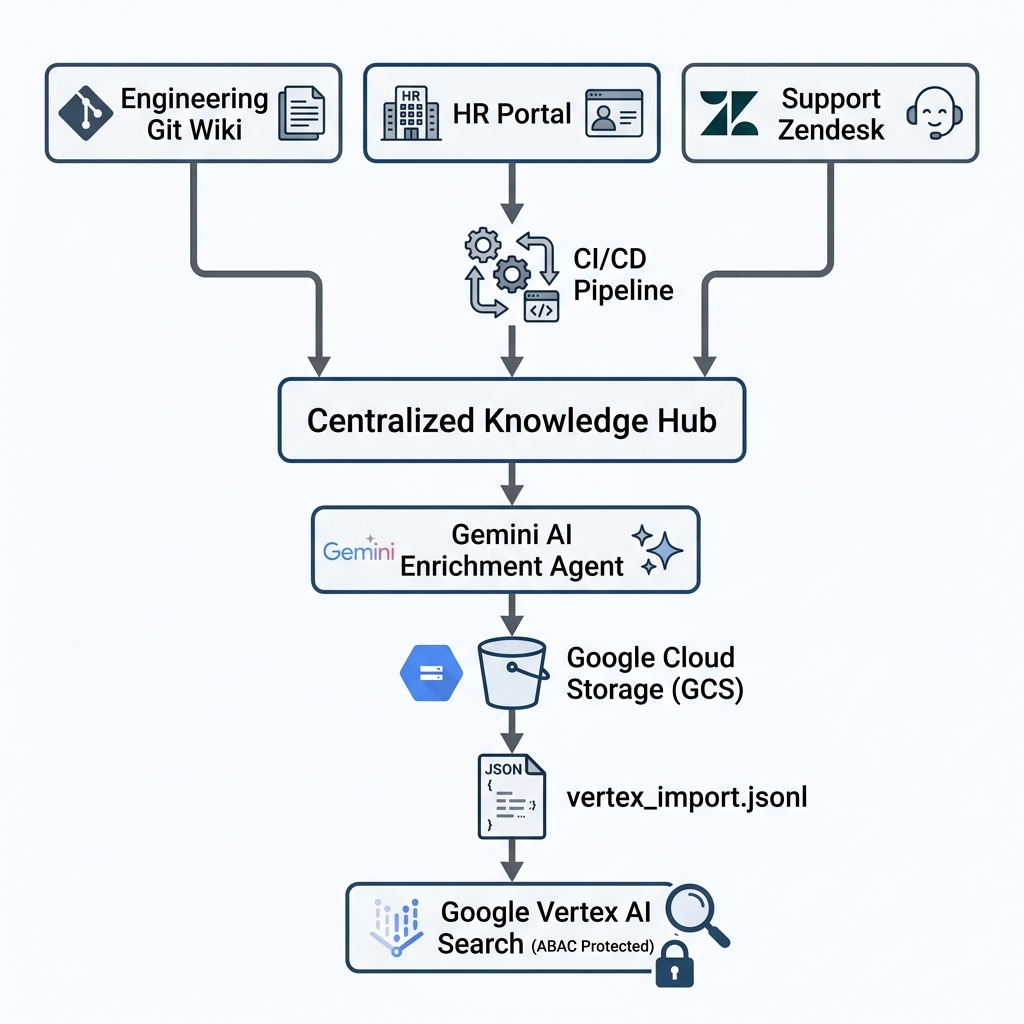
Instead of forcing all departments to migrate to a new, single repository, we maintain a Hub-and-Spoke topology. Data producers continue using their respective standalone systems ("Spokes"). A lightweight automation layer monitors commits, pushes updates to a "Central Hub", enriches documents with YAML metadata using Gemini AI, and publishes a secure index to Google Cloud Storage (GCS) and Vertex AI Search.
Empowering Autonomy: Zero Disruption for Individual Teams
A major roadblock in enterprise knowledge management is the friction of migration. In this
architecture,
each of the 5 or 6 different wikis, Zendesk playbooks, and Git repositories remain
completely independent.
The respective teams continue writing, editing, and using their existing systems exactly as they do
today.
They do not need to change their platforms, learn new editing interfaces, or coordinate security
roles manually.
By keeping the spokes autonomous and running lightweight background syncs to a centralized ingestion pipeline (the Hub), we can scale metadata enrichment via Gemini AI. The AI automatically connects the dots—mapping relationships between an engineering spec from Spoke A and a customer service guide from Spoke B—to build a unified, security-compliant, and contextually rich enterprise search engine.
Standardizing Metadata with Open Knowledge Format (OKF)
The Open Knowledge Format (OKF) is a vendor-neutral, markdown-based specification. It augments raw markdown text by prepending YAML Frontmatter at the top of each file. This frontmatter acts as a structural schema that the database uses to filter and associate information.
Here is an OKF-standardized document layout:
---
id: eng-sys-auth-001
domain: Engineering
title: "OAuth 2.0 User Authentication Architecture"
owner: "Backend Platform Team"
tags: ["security", "auth", "oauth", "credentials"]
allowed_roles: ["engineering", "security-officer", "site-reliability"]
related_entities: ["support-auth-error-001"]
---
# OAuth 2.0 Authentication Protocol
Our microservices utilize standard OAuth 2.0 JWT tokens for secure user logins and session authorization.
Tokens are signed with the RS256 algorithm and expire after 15 minutes.
...
Hands-on Implementation Guide
Step 1: Automating Spoke Syncs (The CI/CD Layer)
Place a lightweight GitHub Action inside each of your source repositories. Whenever a writer merges a PR to the main branch, this script pushes the updated markdown files directly to a designated directory in the Central Hub repository.
Step 2: The OKF AI Enrichment Agent (Gemini API)
Because you want your team members to write freely without manually drafting YAML headers, you build an automated server-side pipeline inside the Central Hub. If a markdown file is added without OKF metadata, a script calls the Gemini 3.5 Flash model to read the document, analyze its content, and automatically write the YAML header.
Step 3: Preparing the GCS Ingestion Manifest
Vertex AI Search requires a single .jsonl manifest file indicating where the raw files live
on Google Cloud Storage and providing the metadata keys to the search engine.
Step 4: Configuring Vertex AI Search Schemas
Once you create your Unstructured Data Store in the Google Cloud Console pointing to your manifest,
configure the schema to map the imported roles (e.g., allowed_roles, domain,
tags) and make them Indexable and Filterable.
Step 5: Enforcing Search-Time Roles (The ABAC Security Layer)
When a user asks a question, your application backend extracts the user's roles from their authentication tokens. When querying the Vertex AI Search API, the application passes a strict filter query to enforce security pre-retrieval.
Why this approach is bulletproof
- The LLM is Never Exposed to Forbidden Data: Security is handled at the database lookup step. A user cannot retrieve search results they don't have permission for.
- Standardized Human-to-AI Interface: OKF standardizes the directory layout. Software developers can read standard markdown folders naturally, while AI scrapers digest YAML boundaries seamlessly.
- Decentralized and Autonomous: Departments simply modify
allowed_rolesin their source repository to restrict access, and the pipeline immediately updates the Vertex AI access index.