
Foundational and Decorative Schema
In enterprise systems, structure is never an afterthought
Databases are modeled before they are queried. APIs are defined before they are consumed. Contracts exist before systems are allowed to interact.
Structured data — particularly formats like JSON-LD — serves the same purpose at the knowledge layer.
It is a machine-readable contract that defines what something is, who owns it, and how it relates to everything else. While often associated with search engines, structured data plays a far more foundational role: it enables systems to reliably interpret, trust, and reuse information across organizational and platform boundaries.
This becomes critical as enterprises move toward AI-driven production systems.
AI agents, assistants, and orchestration frameworks do not operate on intuition — they operate on structure. They require explicit signals to:
- identify authoritative sources
- distinguish intent from presentation
- reason over relationships rather than raw text
This guide introduces a practical distinction that matters both in structured data design and AI system architecture: foundational schemas versus decorative schemas.
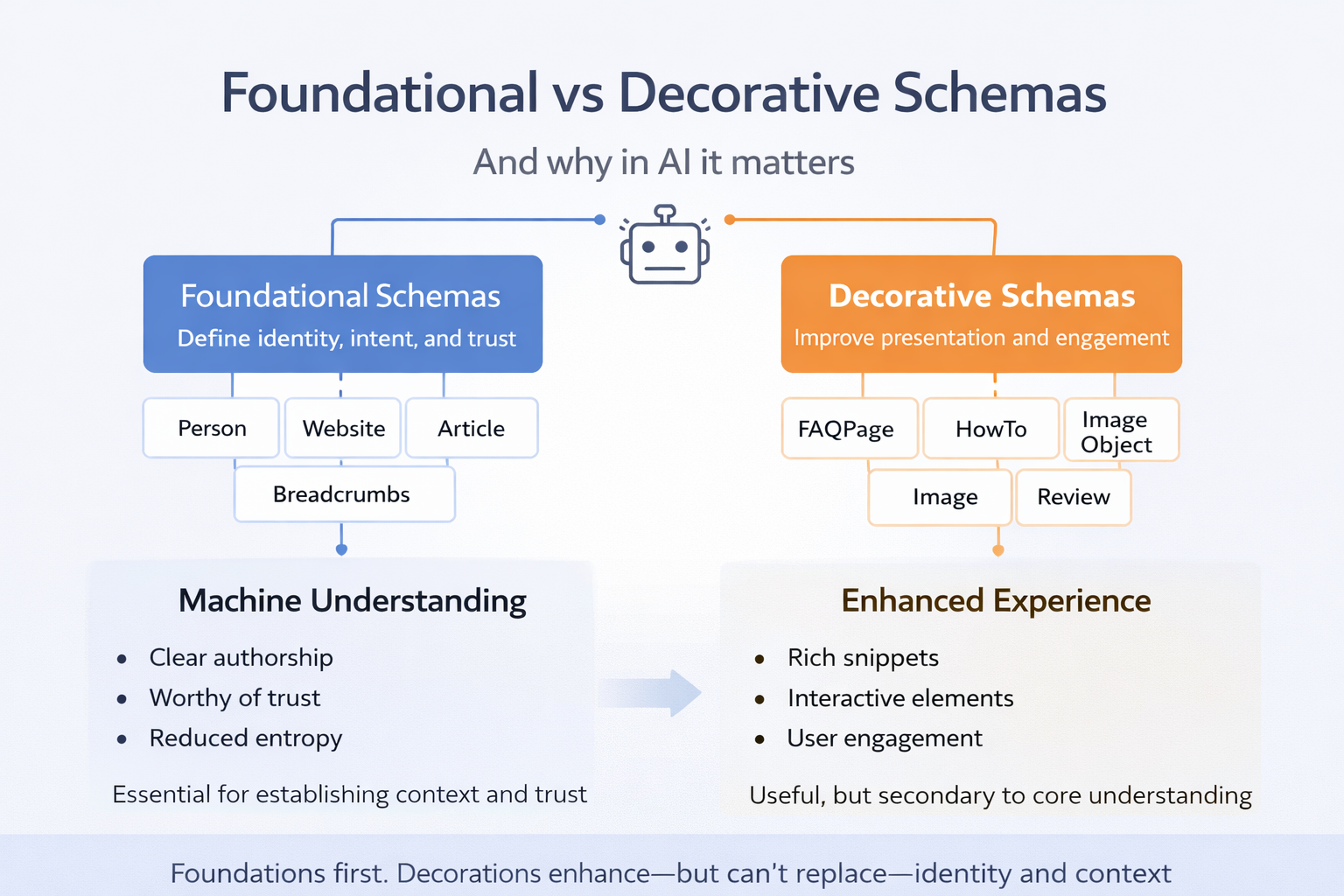
Foundational schemas establish meaning, identity, and trust.
Decorative schemas enhance interaction and experience.
Treating all schemas as equivalent leads to brittle systems — ones that appear functional but fail under scale, change, or automation. Understanding which structures are foundational allows enterprises to build knowledge layers that are resilient, extensible, and AI-ready.
Throughout this guide, we will explore:
- how JSON-LD functions as a semantic contract in enterprise systems
- why some schemas are essential for machine understanding, not visibility
- how this mirrors core principles in AI agent design
- and how to apply this thinking when building production-grade AI applications
Whether you are designing content platforms, internal knowledge systems, or AI-native applications, this framework helps answer a critical question:
What must the system understand before it can meaningfully act?
Because in both enterprise architecture and AI systems, structure always comes before intelligence.
Through Banking and Healthcare AI Systems
When enterprises deploy AI assistants in regulated domains like Banking and Healthcare, success is not determined by how conversational the assistant sounds — it is determined by how reliably the system understands identity, relationships, and authority.
Who Is the Entity?
In enterprise systems, identity is the anchor. Without a canonical definition, AI systems cannot reliably track an entity across disparate datasets.
Banking
Consumer Identity
A customer is a legally defined entity linked to:
- Customer ID
- KYC Profile
- Government Identity
- Risk Profile
JSON-LD unifies these across retail, credit, and fraud systems so AI knows it's the same person.
Healthcare
Member Identity
A patient is an entity fragmented across:
- Insurance Member ID
- Hospital MRN
- Claims & Billing IDs
JSON-LD points all identifiers to a single authoritative Member entity, preventing "Which John Smith?" errors.
Which Source Is Canonical?
Not all data copies are equal. Structured authority allows AI to distinguish between the 'source of truth' and a cached copy.
Banking
Structured data declares:
- Core Banking: Authoritative for balances.
- Mobile Cache: Derivative/Informational.
AI can explain why a number is shown and whether it's real-time or cached.
Healthcare
Authority determines safety:
- EMR: Authoritative for diagnoses.
- Claims: Authoritative for billing.
- Portals: Non-authoritative.
AI surfaces information with provenance, ensuring clinical decisions rely on valid sources.
How Are Entities Connected?
Complex views require traversing a graph. JSON-LD makes these relationships explicit so AI doesn't have to guess.
Banking
A 360-degree view connects:
- Person → Accounts
- Person → Credit cards & Loans
- Person → Investments
Enables queries like "Show all liabilities for this customer" by traversing the graph.
Healthcare
Critical care connections:
- Member → Provider
- Member → Claims & Diagnoses
- Member → Coverage Plan
AI correlates denied claims with coverage rules because the relationship exists before reasoning.
What Does This Data Mean Now?
Data without temporal or situational context is dangerous. Structure ensures answers are operationally valid.
Banking
Context answers:
- Is the account active?
- Is the transaction pending?
- Is the customer under review?
Ensures responses are accurate in the moment, not just historically correct.
Healthcare
Context determines eligibility, care pathways and coverage:
- Coverage periods
- In-network vs Out-of-network
- Pre-authorization status
Prevents technically true but operationally useless answers (e.g., coverage that expired yesterday).
Where Did This Information Come From?
Traceability turns AI from a black box into an auditable system, crucial for regulatory compliance.
Banking
AI can explain:
- Which system produced the data.
- When it was last updated.
- Inferred vs Direct source.
Healthcare
Compliance requirements:
- Clinician-entered vs Patient-reported?
- Imported from partner system?
Prevents AI from overstepping clinical or legal boundaries by knowing the source.
What Is Allowed to Be Used Together?
Security isn't just access control; it's about semantic validity. Some data combinations are restricted.
Banking
Restricted combinations (without consent):
- Behavioral Analytics
- Credit History
- PII
AI respects what it is allowed to know, not just what exists.
Healthcare
HIPAA Constraints:
- PHI vs Administrative Data
- Clinical Notes vs Billing
Agents inherit these constraints by design, enforcing boundaries automatically.
Why Is This Data Being Used?
Separating raw data (intent) from display logic (presentation) keeps reasoning clean and unbiased.
Banking
Query: "What's my exposure?"
- Intent: Risk/Liability data.
- Avoid: Marketing copy, UI hints.
Healthcare
Clinical Reasoning:
- Should ignore UX labels/summaries.
- Must rely on raw clinical facts.
JSON-LD keeps meaning clean while allowing flexible UI layers.
Why This Matters for AI
JSON-LD acts as the semantic backbone that allows AI systems to:
- unify fragmented enterprise data
- reason safely across domains
- produce authoritative, explainable outcomes
Foundational schemas create understanding.
Decorative schemas enhance experience.
Confusing the two leads to AI systems that sound intelligent — but fail when stakes are real.
Now that you have understood what is foundational and decorative schema is
are you interested in how to apply this thinking when building production-grade AI applications using JSON-LD and GraphRAG? Check out our guide on building enterprise grade applications with the RAG to GraphRAG.